

How to break free from Notebook engineering.
Live Your Best Life Now. Only 10 Dollars a Month.


Some time ago, I used my power of divination after decades of writing online to anger the self-righteous pundits of Reddit fame with a critical take on Notebook Engineering. I’ve got their number dialed in. I know human nature and what gets the blood boiling, and yes, I use it to my advantage.
Hey, I’m just human after all, what do you want from me? I’m a slave to my own passions.
An astute reader reached out to me with a very good question, and a difficult one at that, arguably the million-dollar question of many a Data Team.
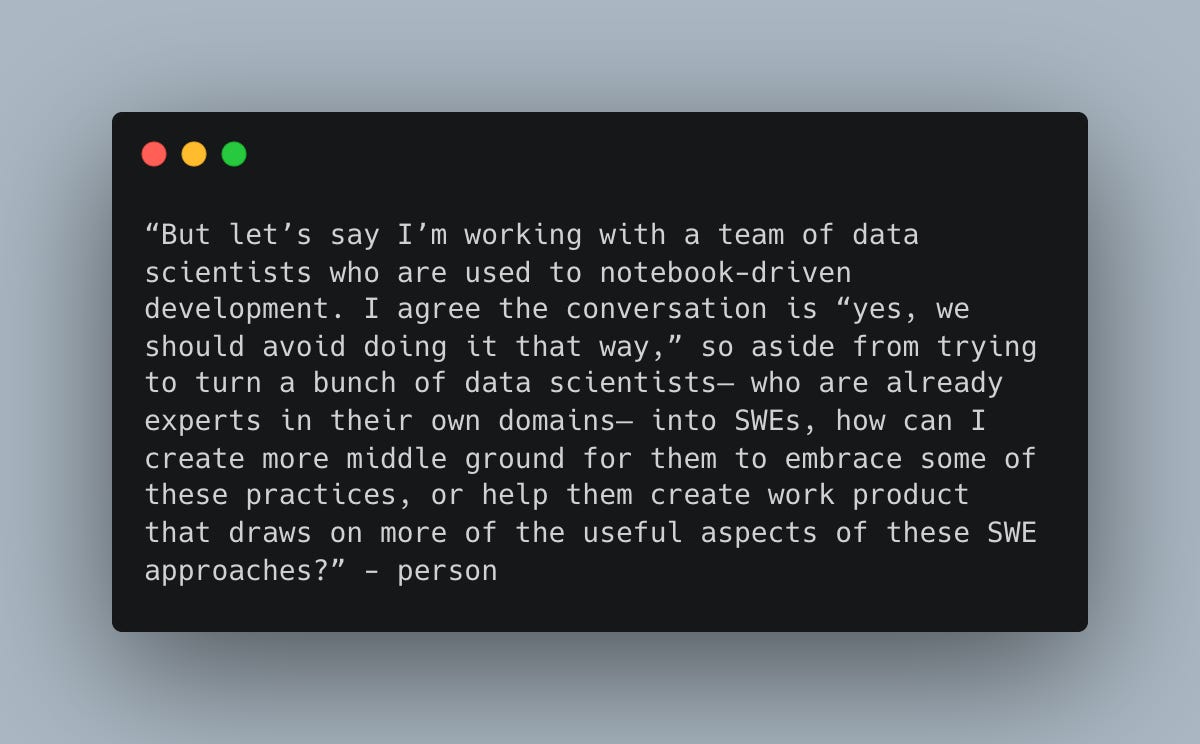
The only downside to this very to-the-point question is that I can’t bumble and mumble my way out of a good answer. I mean, is that all I’m good for? Casting stones at unsuspecting victims?
I would hate for people to think I’ve turned over a new leaf and to offer practical, helpful advice.
This issue is sponsored by Thesys Agent Builder
It helps support his Newsletter by clicking the link below and supporting our generous sponsors who make this content possible.

- No SQL.
- No dashboard building.
- No text-heavy LLM responses pretending to be analysis.
Thesys Agent Builder lets you upload a CSV/XLSX (or connect your database), ask plain-language questions like:
“What are the top-performing regions this quarter?”
“Compare this month’s revenue to last month.”
It’s a shift from dashboards → conversations.
From static reporting → generative UI.
From text answers → visuals you can act on.
Try Thesys Agent Builder — build your own data insights agent in 5 minutes.
Breaking free from Notebook Engineering.
So, you and I, we're gonna have a chat … I'm gonna have a real-life no-bull discussion about hard topics. I truly hope you don’t get your poor feelings hurt and go running to Ma and tattle on me. Do what you have to; I can’t take it.
Methinks that a Notebook Engineer is more of a way of life. Is it not?
It’s an identity, it’s who someone is. Or a team. Or a company.
What a “Notebook Engineer” is

A notebook engineer is someone who uses tools like Jupyter or Databricks notebooks
as their primary way of building, running, and even deploying data workflows—often
far beyond what notebooks were originally intended for.
Look. There is no longer any excuse. You don’t even have to write the flipping code yourself anymore. You can one-shot your way to Claude or Cursor glory while lying on the couch scrolling through Netflix. Don’t lie, I see you.
The main problem is that the Notebook Engineering mindset follows you down the AI path and probably just amplifies the bad habits you have already adopted.
This is why a junior developer armed with Claude Code might ship more while still being a Junior Developer. Yes, with the capital letters and all. Everything has changed, and nothing has changed. Code was never how someone got promoted to Senior+ levels in tech.
Here is my list of ways people can break free from Notebook Engineering … but doing the OPPOSITE of what I list below. These are the traits of someone trapped in Notebook Engineering.
Traits of Notebook Engineering Mindset
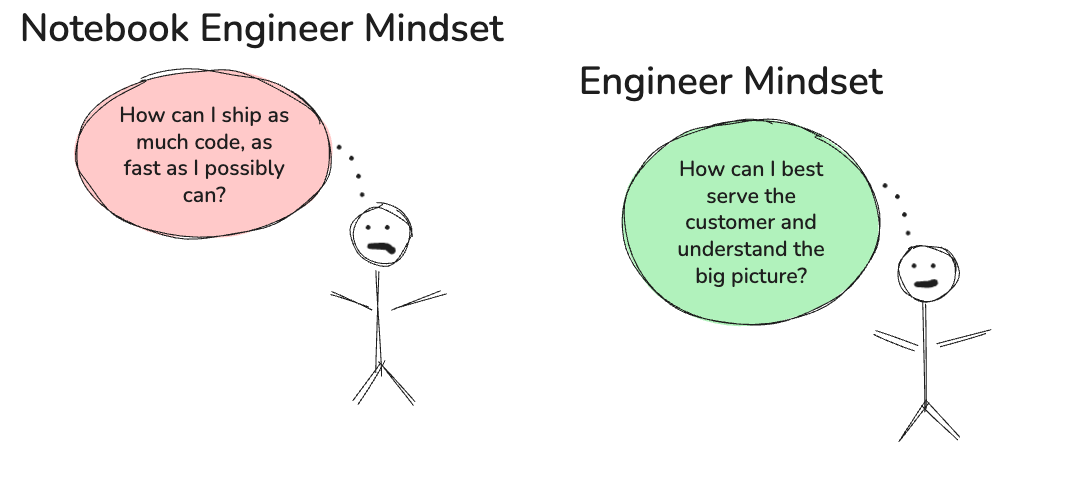
They do most (or all) development in notebooks rather than in proper codebases, scripts, or structured pipelines.
It is no longer a helper or an exploratory tool; it’s a way of life.
They treat notebooks not just as a place to explore data, but as the final implementation, even in production environments.
Optimizes for speed and ease, not rigor
Avoids (or lacks) traditional SWE practices
Testing is never done, or rarely done
There is no system design or thinking. They see the world as one giant Notebook attached to Serverless.
Common gaps:
testing
modular code
version control hygiene
reproducibility
Save me your speech on how you unit-test your Python Notebooks. I believe probably 1 out of 100 people do that. The truth is, there are no more excuses, not with Cursor and Claude becoming our fingers.
Do you struggle with writing code that reflects software best practices?
There is almost nothing AI is better at than writing unit tests for you, making your code clean and modular, heck, it’s great at setting up CI/CD pipelines and the rest. All that busy work that kept you from doing the right thing in the first place, you don’t even have to do it yourself anymore!
